
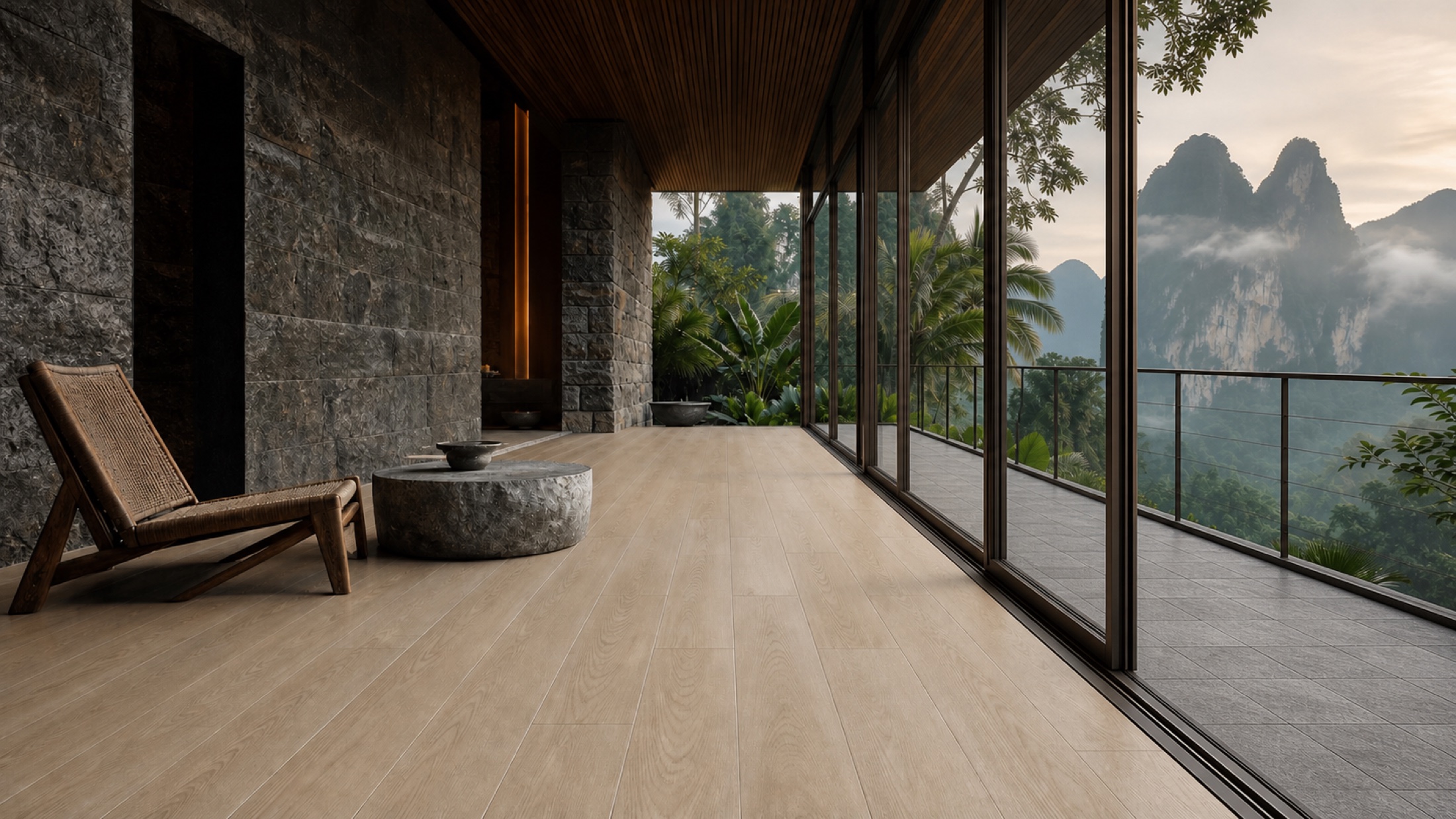
GENERATIVE APPLICATION VISUAL · FACTORY-GROUNDED PRODUCT FORM · NOT A COMPLETED PROJECT
Opportunity IdentifiedOP-001
SPC Rigid Core Click Flooring
A rigid click flooring system considered for humid climates, rapid refurbishment and standardized project delivery.
VietnamIndonesiaThailandMalaysia
Ordinary grades outdoors
01
Quick orientation
02
Why this is an opportunity product
A product earns attention only when market demand, climate, supply, project delivery, commercial logic and compliance can be considered together.
A rigid click flooring system considered for humid climates, rapid refurbishment and standardized project delivery.
- Moisture performance is generally stronger than ordinary wood-fibre core flooring
- Click installation can reduce wet trades and programme time
- Suitable for selected renovation over sound existing tile
- SPC flooring and SPC wall panels may share a mineral-polymer core, but they are not automatically interchangeable. Wall use needs a panel format and fixing method approved for vertical installation.
 GENERATIVE APPLICATION VISUAL · FACTORY-GROUNDED PRODUCT FORM · NOT A COMPLETED PROJECT
03
Opportunity analysis
4/5
Market Demand
UBI market assessment
4/5
Climate Fit
UBI market assessment
5/5
Design Range
UBI market assessment
4/5
Project Fit
UBI market assessment
4/5
Commercial Potential
UBI market assessment
3/5
Compliance Complexity
Pending verification
UBI preliminary market judgement. It is not an investment-return guarantee.
04
SPC and alternatives
No product is universally superior; selection depends on exposure, duty, interfaces, programme, service life and maintenance.
| System | Environmental basis | Delivery | Typical project | Key caveat |
|---|---|---|---|---|
| SPC | Strong board-level resistance | Fast floating click installation | Residential, hotel, office and retail refurbishment | Harder underfoot; substrate and heat still matter |
| Laminate | Core quality dependent | Fast | Dry residential and light commercial interiors | Wood-fibre cores may swell after moisture exposure |
| Ceramic tile | Excellent system potential when detailed | Slower wet trade | Wet areas, heavy wear and long service life | Heavier, slower refurbishment and harder replacement |
| WPC | Product dependent | Fast | Comfort-led interiors | Softer foamed core; not the same product as SPC |
| LVT | Strong material resistance | Glue-down preparation can take longer | Large commercial layouts and design flexibility | Subfloor telegraphing and adhesive system matter |
Ordinary grades outdoors · Long-term standing water · Pool surrounds and commercial kitchens · Heavy forklift or aggressive chemical areas · Unmitigated strong solar exposure
05
Application scenarios
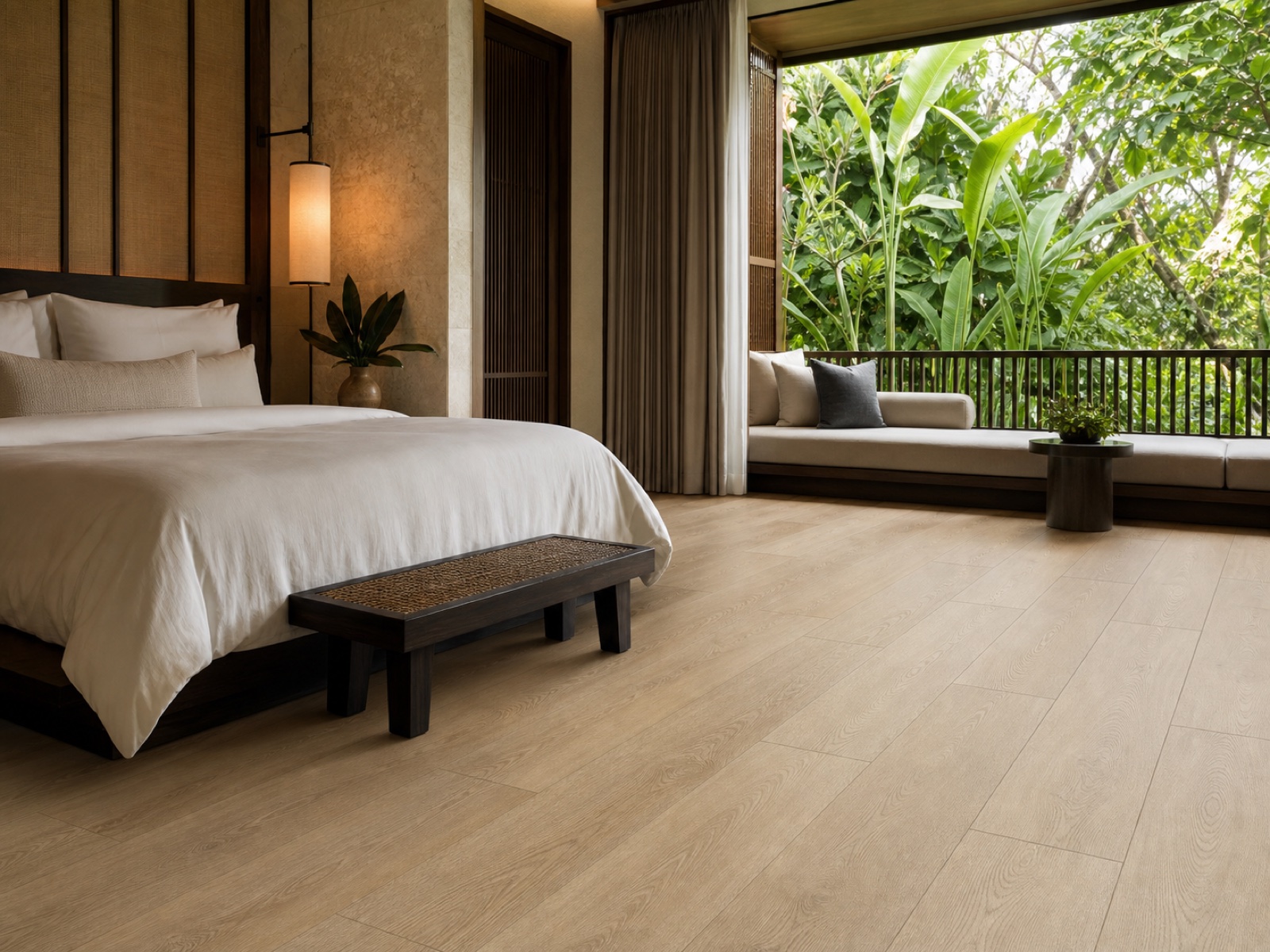
Original application images communicate design intent and system boundaries; they are not photographed completed projects.
FLOOR · Market Reference
Hotel guest room
Guest rooms and dry corridors after traffic, slip, fire and VOC review.
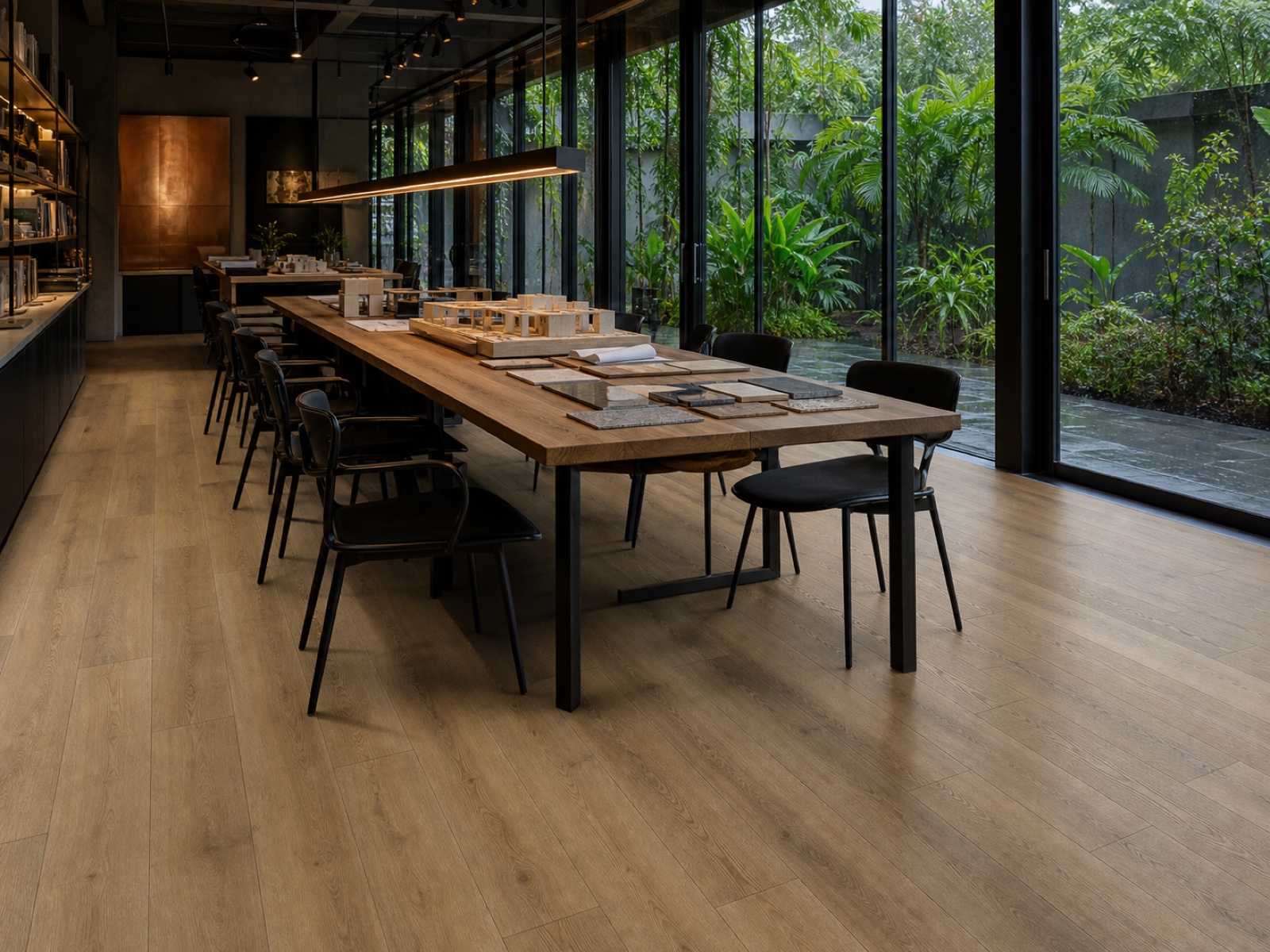
FLOOR · Market Reference
Office & studio
Open office, meeting and reception zones with suitable castor and wear performance.
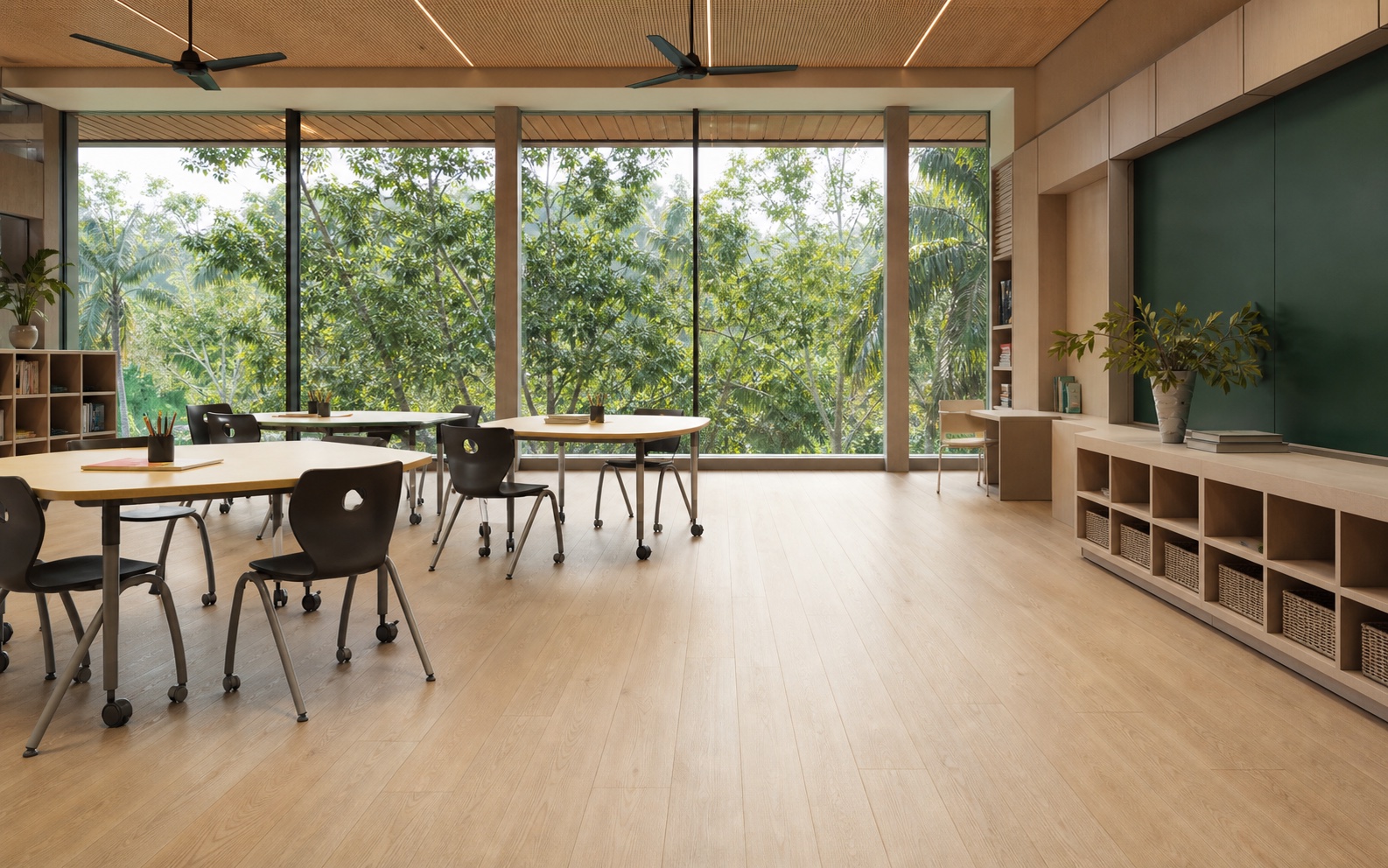
FLOOR · Market Reference
School classroom
Classrooms and training rooms subject to fire, slip, VOC, acoustics and furniture-load evidence.
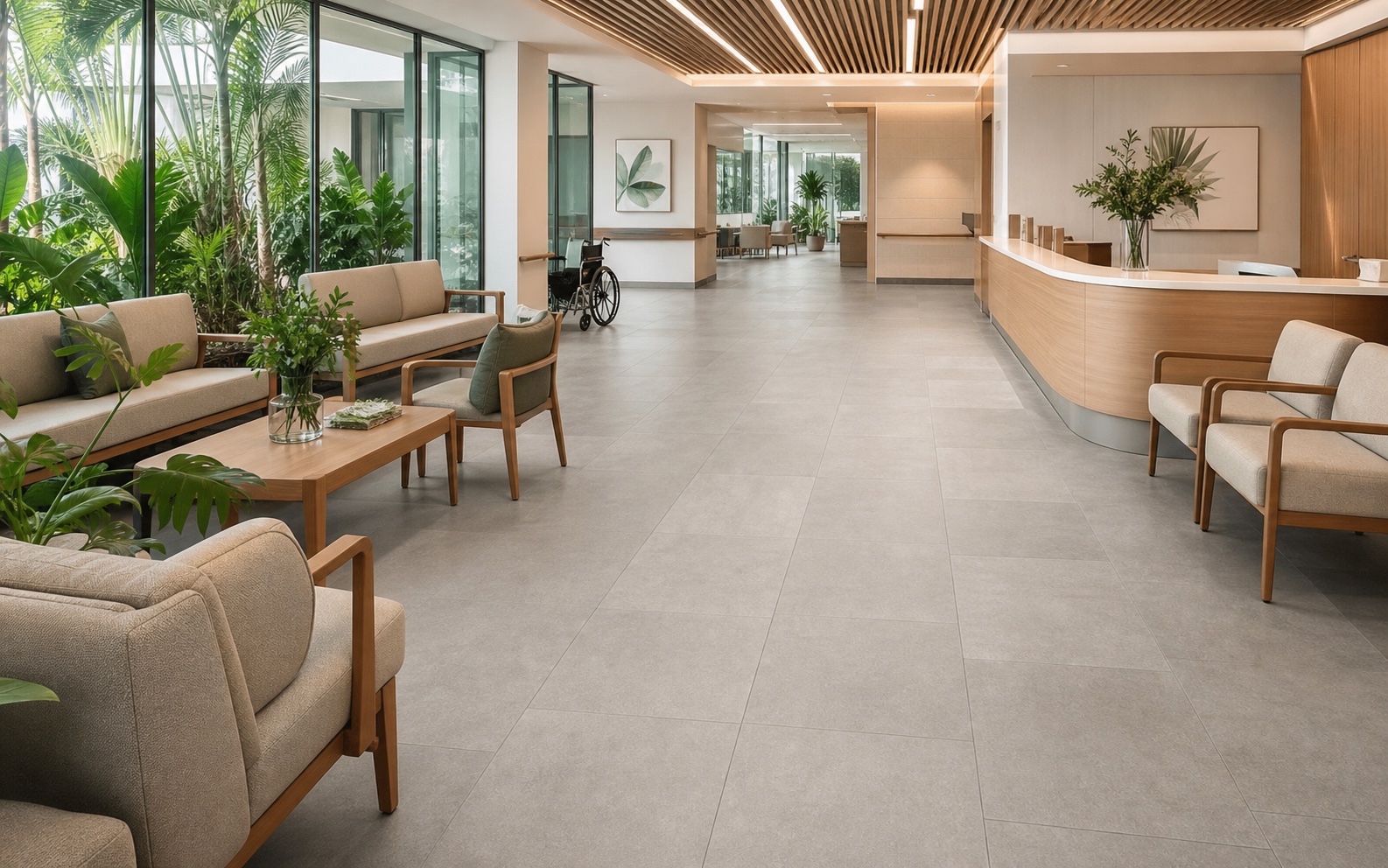
FLOOR · Pending Verification
Hospital support zone
Administration, waiting and non-special support areas only; not sterile, wet-treatment or operating zones.
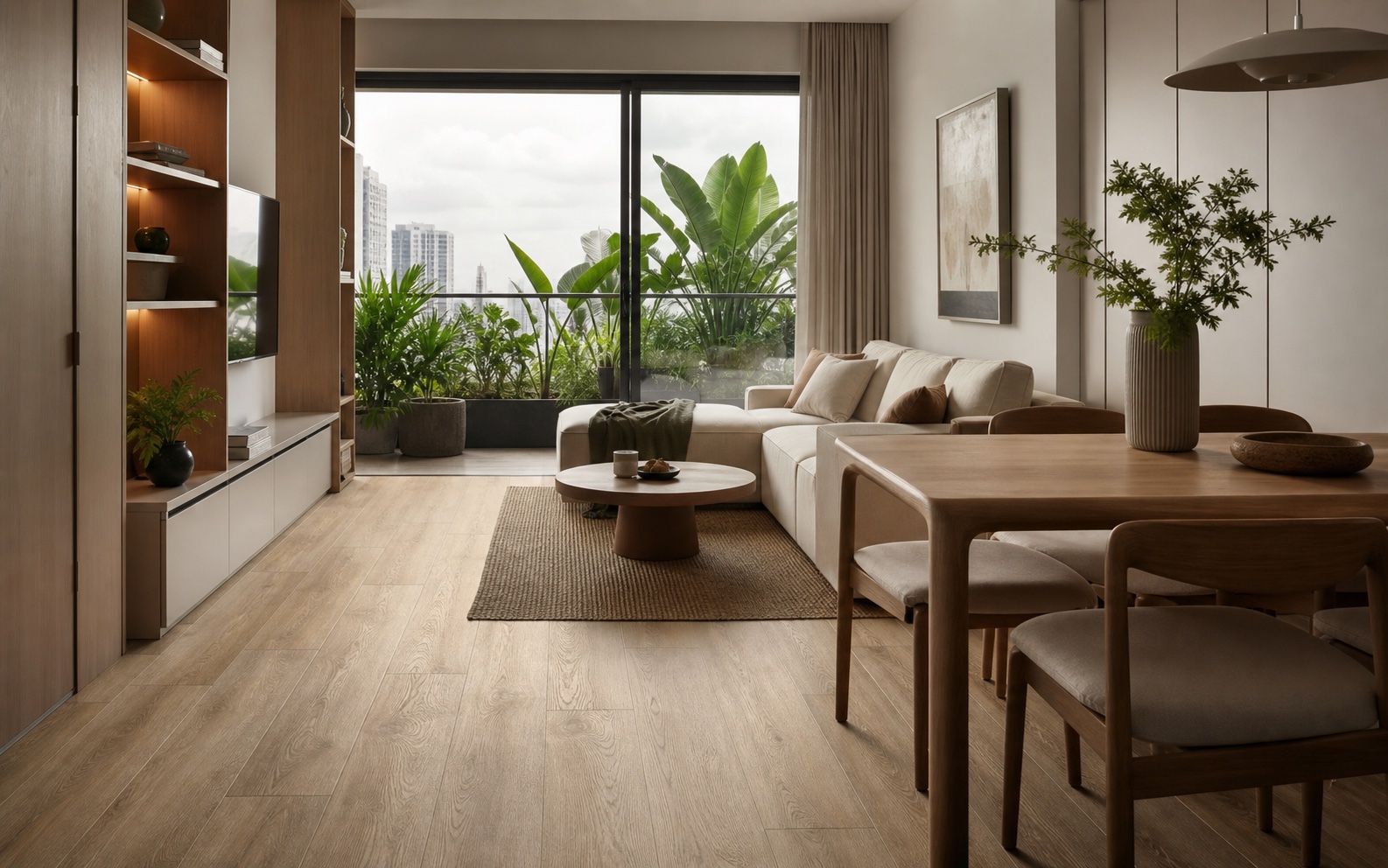
FLOOR · Market Reference
Urban apartment
Living, dining and bedroom areas with an indoor/outdoor threshold and controlled solar exposure.
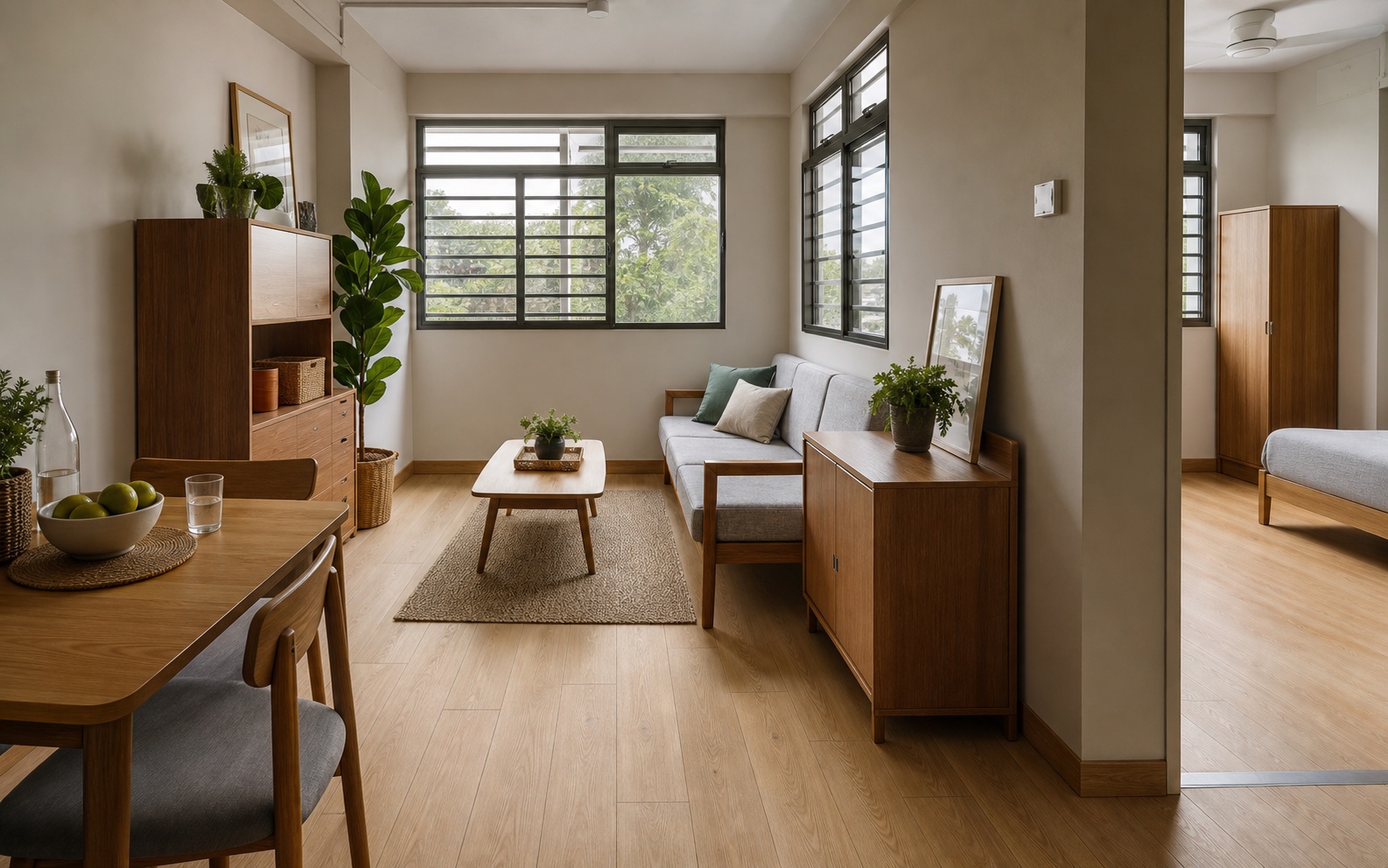
FLOOR · Market Reference
Public & affordable housing
Standardized dry interiors where batch colour, replacement stock, VOC and warranty are documented.
Residential
- Living rooms
- Bedrooms
- Rental apartments
- Show homes
Hospitality
- Guest rooms
- Corridors
- Serviced apartments
- Staff accommodation
Commercial & institutional
- Offices
- Retail
- Classrooms and training rooms
- Hospitals—administration and non-special clinical support areas
Public & affordable housing
- Standardized apartment interiors
- Bedrooms and living areas
- Rapid turnover refurbishment
- Projects with documented VOC and wear requirements
Not recommended without specific design review
Ordinary grades outdoors · Long-term standing water · Pool surrounds and commercial kitchens · Heavy forklift or aggressive chemical areas · Unmitigated strong solar exposure
06
Southeast Asian climate fit
High humidity, monsoon rain, condensation, coastal exposure, solar gain and substrate moisture must be considered as a system.
High humidity and seasonal moisture
- Potential advantage
- The rigid mineral-polymer core is not primarily wood fibre and generally resists moisture-related swelling better than ordinary laminate cores.
- Remaining limitation
- Moisture may still be trapped below a floating floor; joints, walls and subfloors are not automatically waterproof.
- Design & installation response
- Test slab moisture, provide the specified vapour control layer, keep expansion gaps and investigate any water ingress promptly.
Solar gain and high temperature at glazing
- Potential advantage
- Qualified products can offer useful dimensional stability in controlled interiors.
- Remaining limitation
- Strong direct sun and rapid thermal cycling can still cause movement, gapping or distortion.
- Design & installation response
- Assess solar exposure, use shading, confirm heat-stability test data and provide movement zones for large areas.
Ground-floor and below-grade moisture
- Potential advantage
- Floating installation can reduce wet trades and allow rapid fit-out.
- Remaining limitation
- A rigid board cannot correct a damp, uneven or contaminated substrate.
- Design & installation response
- Check flatness and moisture, repair the slab, use approved moisture control and never trap active dampness.
07
Product structure
A functional system diagram for opportunity screening; exact supplier construction and interfaces must be confirmed.
1UV surface coating
2Transparent wear layer
3Printed décor film
4Rigid SPC core
5Balance layer
6IXPE acoustic backing
01UV surface coating
Wear, stain and gloss control; performance depends on formulation and cure.
02Transparent wear layer
A key determinant of wear suitability; project evidence required.
03Printed décor film
Carries wood, stone, terrazzo, carpet or concrete visuals.
04Rigid SPC core
Mineral-filled polymer core providing rigidity and click profile.
05Balance layer
Supports dimensional balance and back-side performance.
06IXPE acoustic backingOptional
Optional pre-attached layer for comfort and impact-sound improvement.
08
Typical raw materials
Rigid core
- PVC resin
- Calcium carbonate
- Stabilizers and lubricants
- Processing and impact modifiers
Surface system
- UV-cured coating
- Transparent wear layer
- Printed décor film and embossing
Backing & accessories
- Balance layer
- Optional IXPE or EVA
- Specified vapour control layer
Specific formulation, proportions and chemical content must follow manufacturer technical data, SDS and third-party reports.
09
Manufacturing process
- 01Raw-material weighing
- 02Hot and cold mixing
- 03Extrusion and plasticisation
- 04Calendering or lamination
- 05Surface lamination and UV curing
- 06Conditioning and cutting
- 07Profiling, click machining and bevel
- 08Optional backing lamination
- 09Inspection and packaging
Quality control that materially affects results
Formula stability and internal stress · Heat shrinkage, thickness and flatness · Click precision and toughness · UV adhesion and batch colour · VOC, odour and restricted substances · Backing adhesion and transport deformation
10
Collections
Configuration families support early project screening. Final models, capacities, finishes and interfaces require a current supplier matrix and project selection.
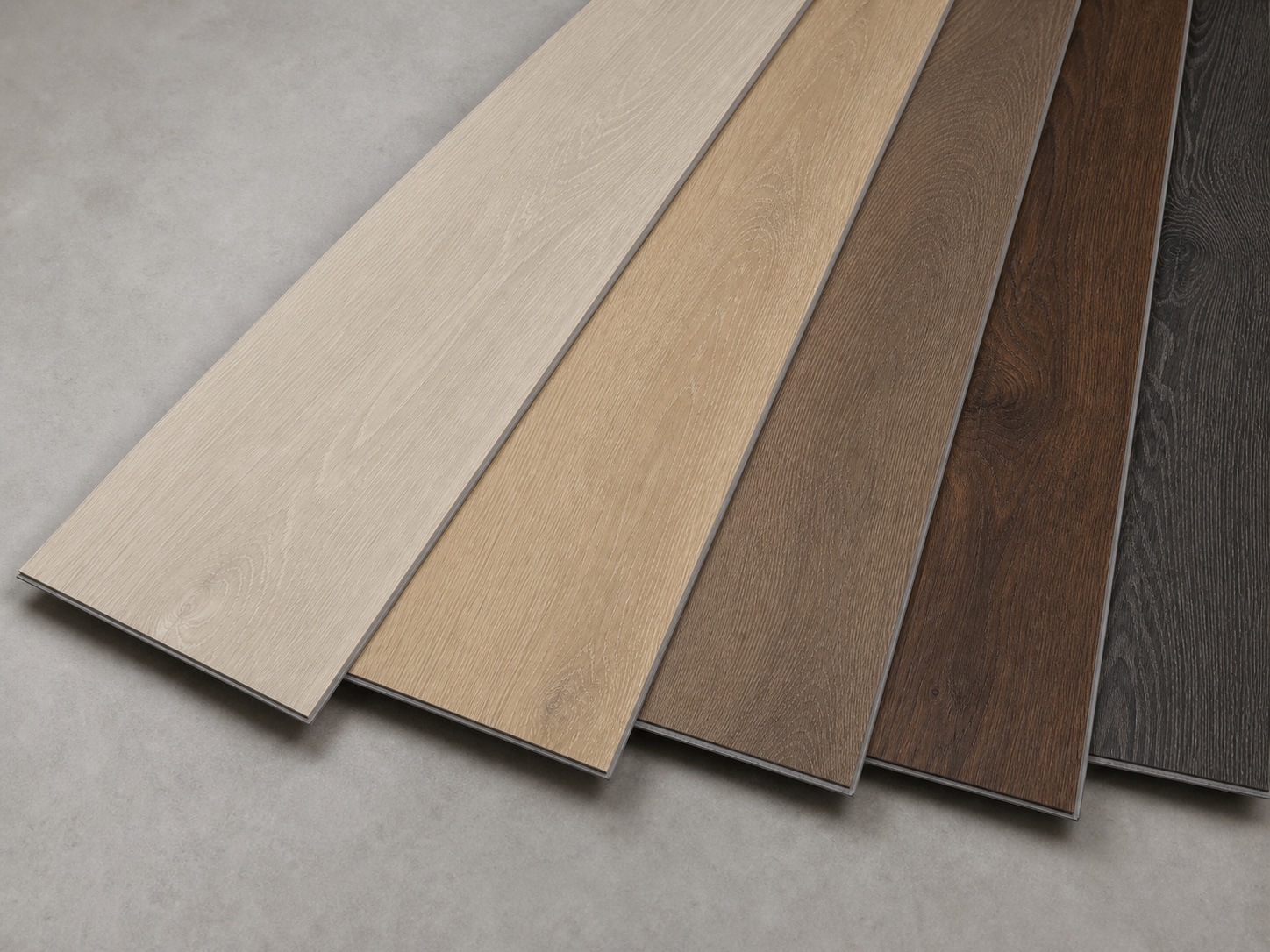
Oak spectrum
Quiet Nordic lights through smoked and fumed darks, with matte registered embossing.
- OW-01Limestone OakPale neutral
- OW-02Natural Atelier OakLight warm
- OW-03Honey Smoked OakMid warm
- OW-04Mocca OakMid dark
- OW-05Walnut OakDeep warm
- OW-06Fumed Charcoal OakDeep cool
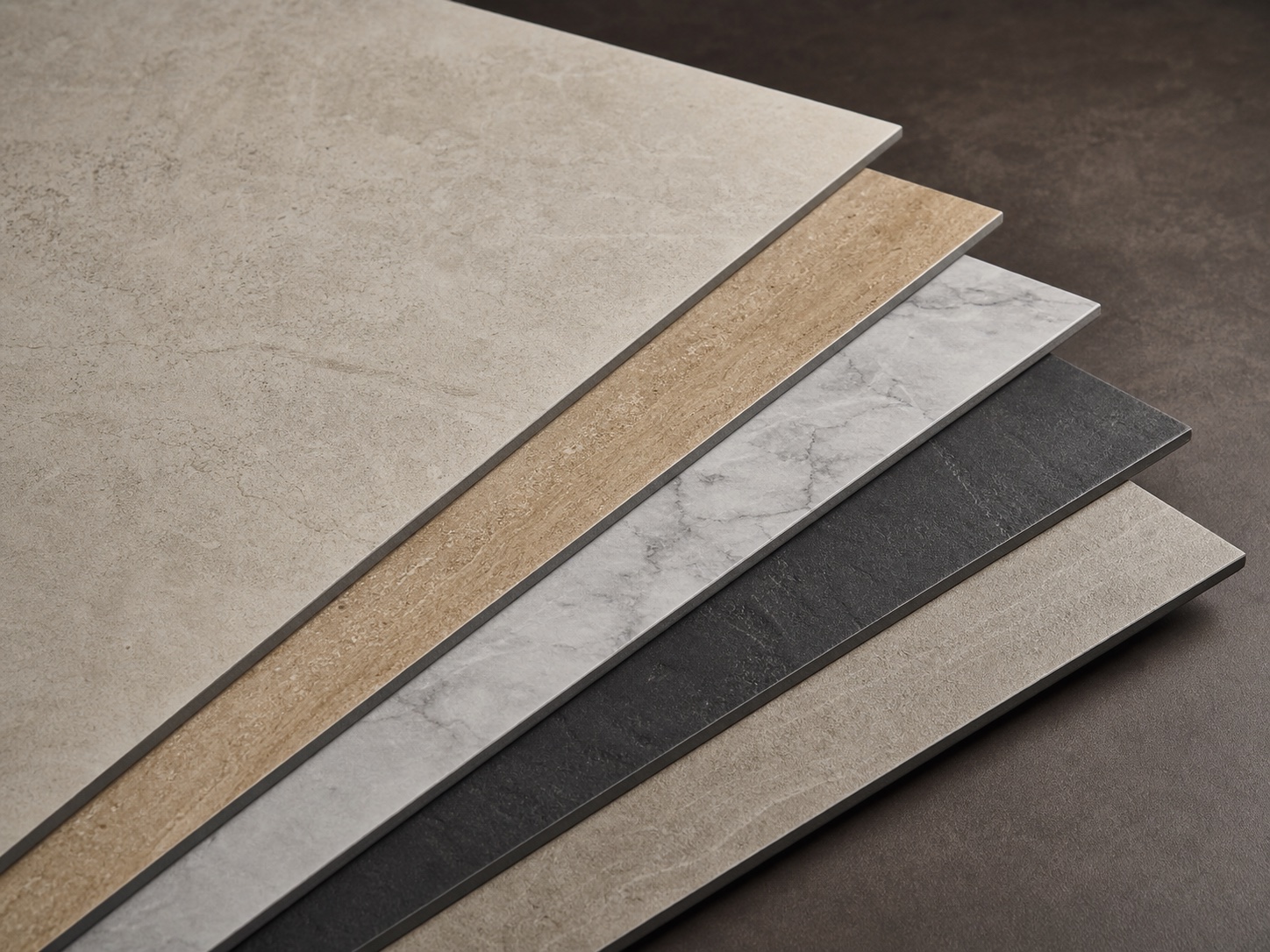
Mineral stone
Large-format limestone, travertine, marble, slate and sandstone references for floors and approved wall panels.
- ST-01Pale LimestoneSoft ivory
- ST-02Warm TravertineWarm sand
- ST-03Silver VeinCool white
- ST-04Graphite SlateDark mineral
- ST-05Greige SandstoneBalanced greige
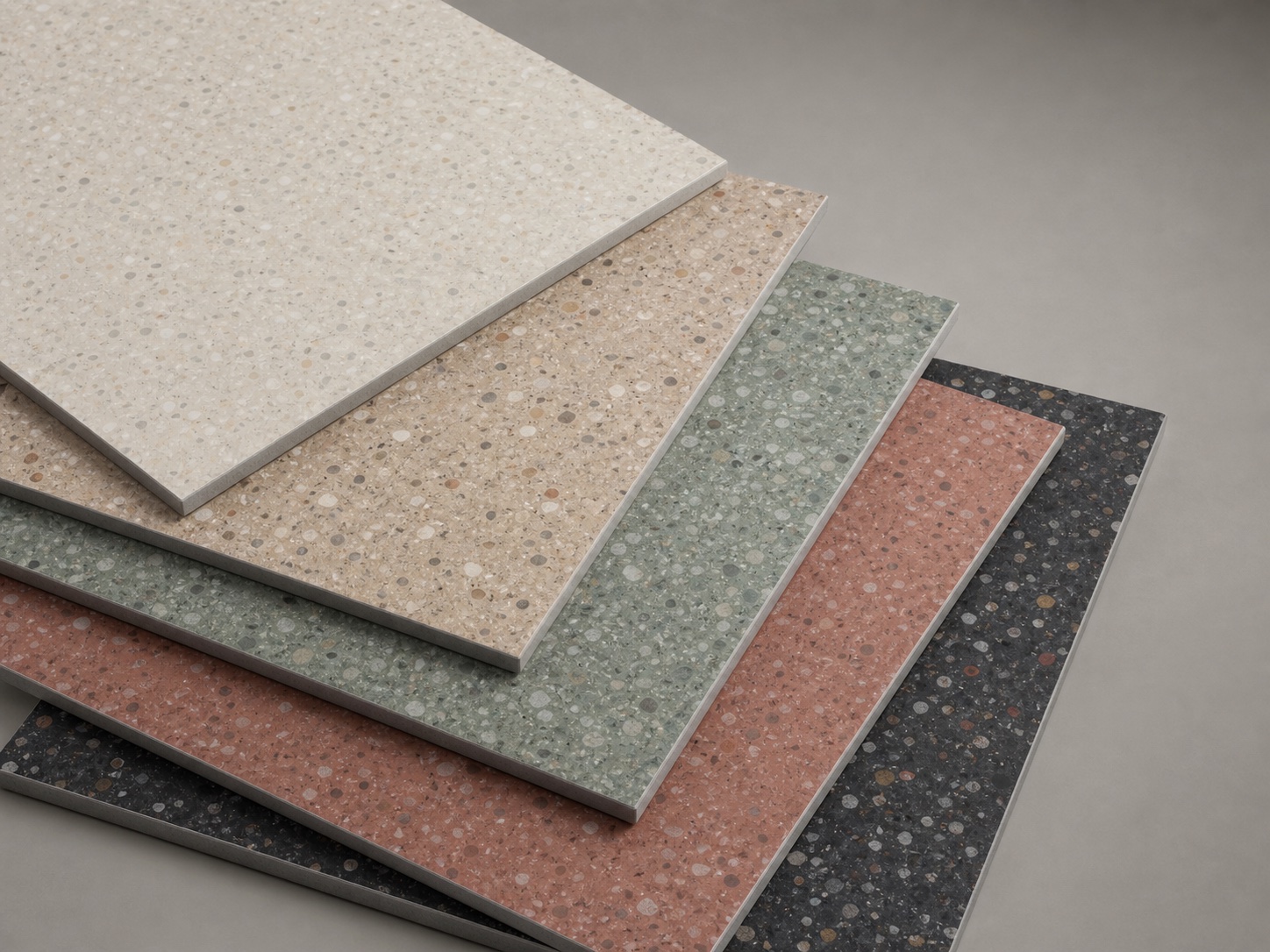
Terrazzo studio
Fine and medium aggregate visuals for education, hospitality, retail and residential schemes.
- TZ-01Ivory ConfettiLight neutral
- TZ-02Desert AggregateWarm beige
- TZ-03Sage MineralMuted green
- TZ-04Clay StudioRose clay
- TZ-05Night AggregateCharcoal multicolour
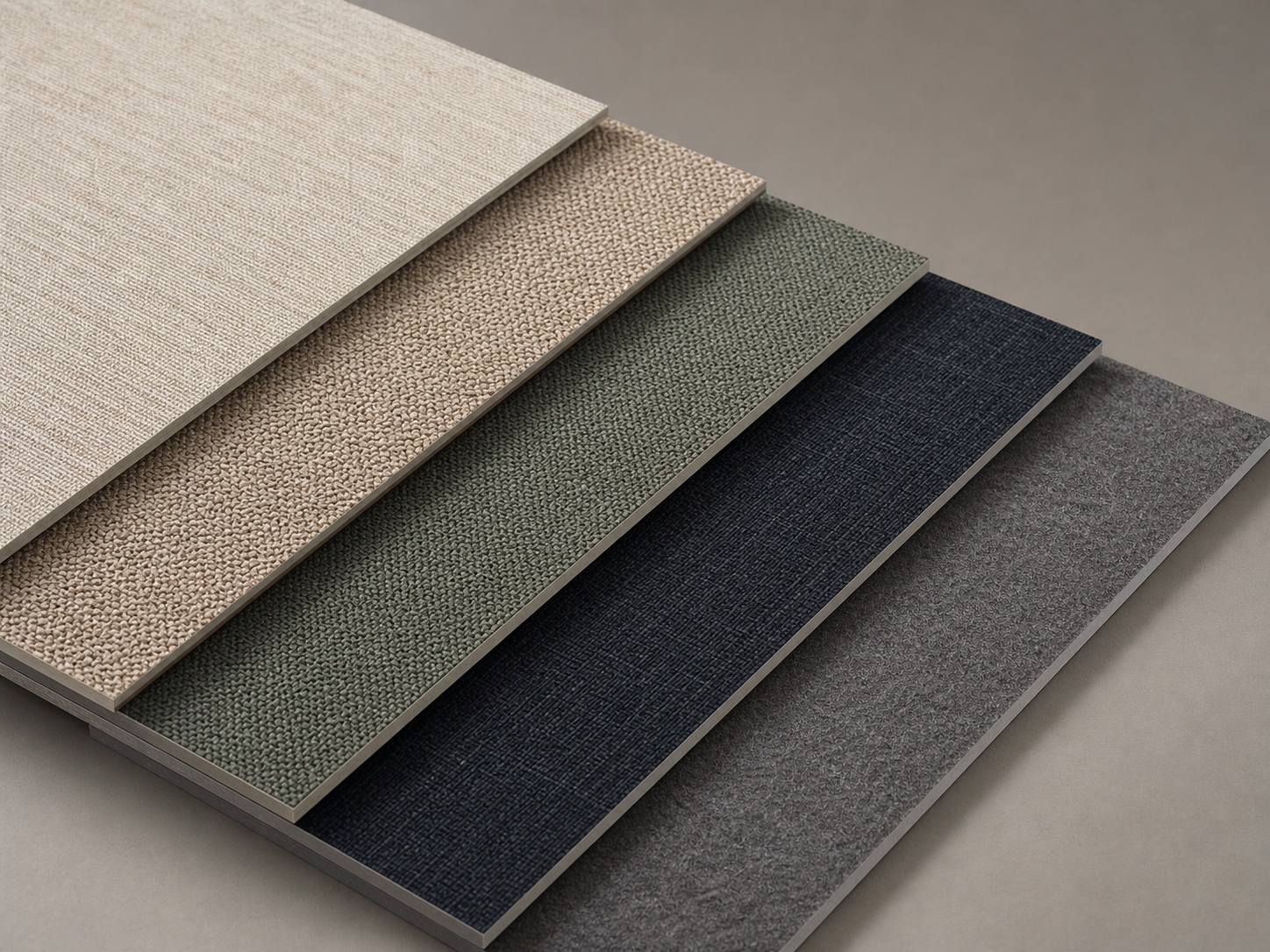
Textile relief
Low-glare woven textures for wall features and selected low-contrast flooring concepts.
- TX-01Linen WhiteWarm light
- TX-02Bouclé GreigeSoft greige
- TX-03Moss WeaveMuted green
- TX-04Ink CrosshatchDeep blue black
- TX-05Charcoal FeltCharcoal
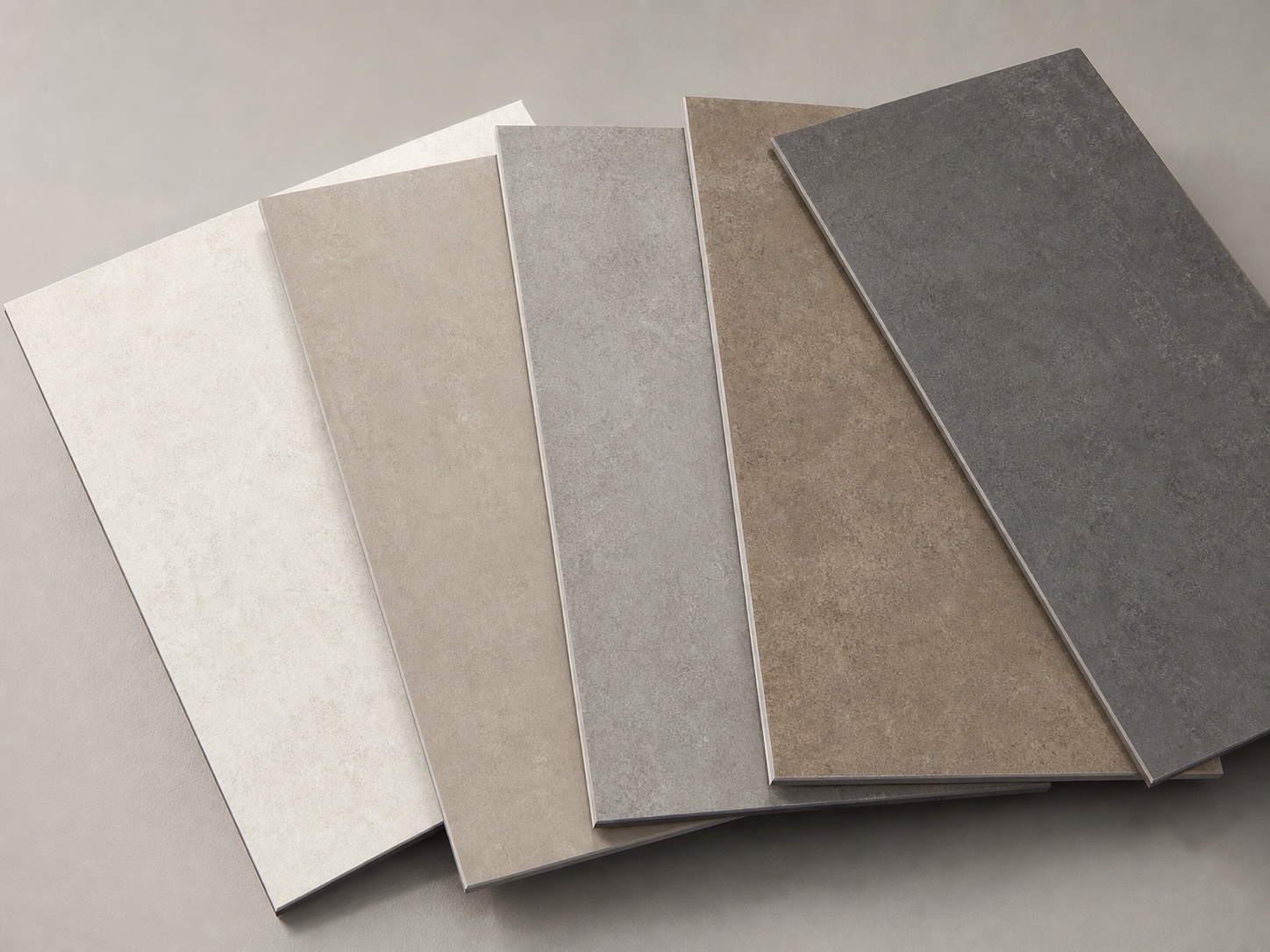
Architectural concrete
Calm microcement and trowelled concrete references from chalk white to graphite.
- CN-01Chalk ConcreteOff white
- CN-02Warm MicrocementWarm greige
- CN-03Gallery GreyMid neutral
- CN-04Clay CementMuted earth
- CN-05Graphite FormworkDeep grey
11
Technical specifications
System scopeSPC rigid-core floor plus purpose-designed SPC interior wall-panel optionManufacturer Declared
Floor product standardSelect product tested to the applicable resilient / rigid-core standard for the destination marketPending Verification
Total thicknessProject selection required; exact nominal and tolerance from final TDSPending Verification
Wear layerSelect by traffic class, abrasion evidence and warrantyPending Verification
Plank / tile formatWood plank, herringbone plank and large-format tile options; supplier confirmation requiredManufacturer Declared
Wall-panel formatLarge-format vertical panels or approved click panels; exact size and weight from wall-system TDSManufacturer Declared
Core compositionMineral-filled polymer rigid core; exact formulation and recycled content require declarationManufacturer Declared
Core densitySupplier declaration plus batch verification requiredPending Verification
Surface treatmentUV-cured coating with project-selected gloss, stain and scratch performanceManufacturer Declared
EmbossingWood, stone, terrazzo, textile or concrete embossing; EIR available by supplierManufacturer Declared
BevelSquare, micro-bevel or painted bevel by collectionManufacturer Declared
Floor locking systemFour-sided click profile; licensed profile and pull-strength evidence to be nominatedPending Verification
Acoustic backingOptional IXPE/EVA; thickness, adhesion and acoustic report must match the offered SKUPending Verification
Use classificationSelect by domestic, commercial or industrial traffic and destination-market standardPending Verification
Dimensional stabilityCurrent product-specific heat and dimensional-stability report requiredPending Verification
Thickness swell / water exposureBoard result does not establish waterproof joints or assembly; product-specific report requiredPending Verification
Reaction to fireProject-required floor and wall classifications must be verified separatelyPending Verification
Slip resistanceDry/wet test method and declared result must match the use zonePending Verification
Static load & residual indentationVerify for furniture, partitions, hospital equipment and commercial usePending Verification
Castor-chair resistanceProduct-specific test required for offices and schoolsPending Verification
Impact soundAssembly-specific laboratory result required; backing-only claims are insufficientPending Verification
Underfloor heatingOnly within manufacturer temperature limits and approved floor build-upPending Verification
VOC / indoor air qualityCurrent third-party certificate for the exact manufacturing site and SKUPending Verification
Phthalates, heavy metals & formaldehydeDestination-market restricted-substance reports requiredPending Verification
Wall substrateFlat, sound, clean, dry and compatible with the specified adhesive/fixing systemManufacturer Declared
Wall fixingManufacturer-approved full-spread/strip adhesive and/or mechanical fixing with edge trimsManufacturer Declared
Wet-wall detailingPrepared waterproof substrate plus sealed joints, corners, penetrations and terminationsManufacturer Declared
Exterior exposureNot included unless a separate façade/weathering system is tested and warrantedPending Verification
Packaging & batch controlCarton quantity, pallet loading, batch colour and spare-stock plan from final supplierPending Verification
WarrantySeparate floor and vertical-use warranties, exclusions and maintenance conditions requiredPending Verification
12
Balanced assessment
Potential advantages
- Moisture performance is generally stronger than ordinary wood-fibre core flooring
- Click installation can reduce wet trades and programme time
- Suitable for selected renovation over sound existing tile
- Wide visual range and straightforward routine cleaning
- Coordinated floor, wall-panel and skirting concepts can create a complete interior system
Real constraints
- Usually harder underfoot than timber and WPC
- Cannot be repeatedly sanded like solid timber
- Poor locks can chip or fatigue on uneven substrates
- Heat and intense sunlight can drive distortion
- Environmental claims require VOC, heavy metal and phthalate evidence
13
Service life and warranty
- Expected service life is not a warranty promise
- Limited warranty depends on supplier terms and exclusions
- Project-specific warranty must be agreed in the contract
14
Installation and maintenance
Before installation
- Check slab moisture and flatness
- Confirm temperature and site acclimation
- Plan setting-out and expansion zones
During installation
- Use the specified vapour layer
- Maintain perimeter gaps and doorway transitions
- Do not trap floating floors below fixed cabinets
After installation
- Use furniture pads and suitable castors
- Protect strong solar-exposure zones
- After flooding, dismantle and dry the substrate promptly
15
Interior wall system
SPC can be specified vertically when the selected product is engineered, tested and warranted as a wall panel system.
DEEP SYSTEM · Manufacturer Declared
SPC interior wall panel system
SPC flooring and SPC wall panels may share a mineral-polymer core, but they are not automatically interchangeable. Wall use needs a panel format and fixing method approved for vertical installation.
- Hotel lobbies, guestrooms and corridors
- Apartment feature walls and headboards
- Office reception and meeting rooms
- Retail and commercial interiors
- Manufacturer-rated bathroom wet walls
- Flat, sound, clean and dry substrate
- Specified adhesive and/or mechanical fixing
- Defined joint, corner, penetration and edge details
- Project fire, VOC and impact evidence
- Wet-area waterproof substrate and sealed system where applicable
- Vertical-use warranty from the selected manufacturer
- Do not assume ordinary floating floor planks are wall-rated
- Not for exterior façades unless separately weather-tested and warranted
- Do not rely on the finish panel as the sole waterproofing layer
- Wet walls require sealed manufacturer details around every joint and penetration
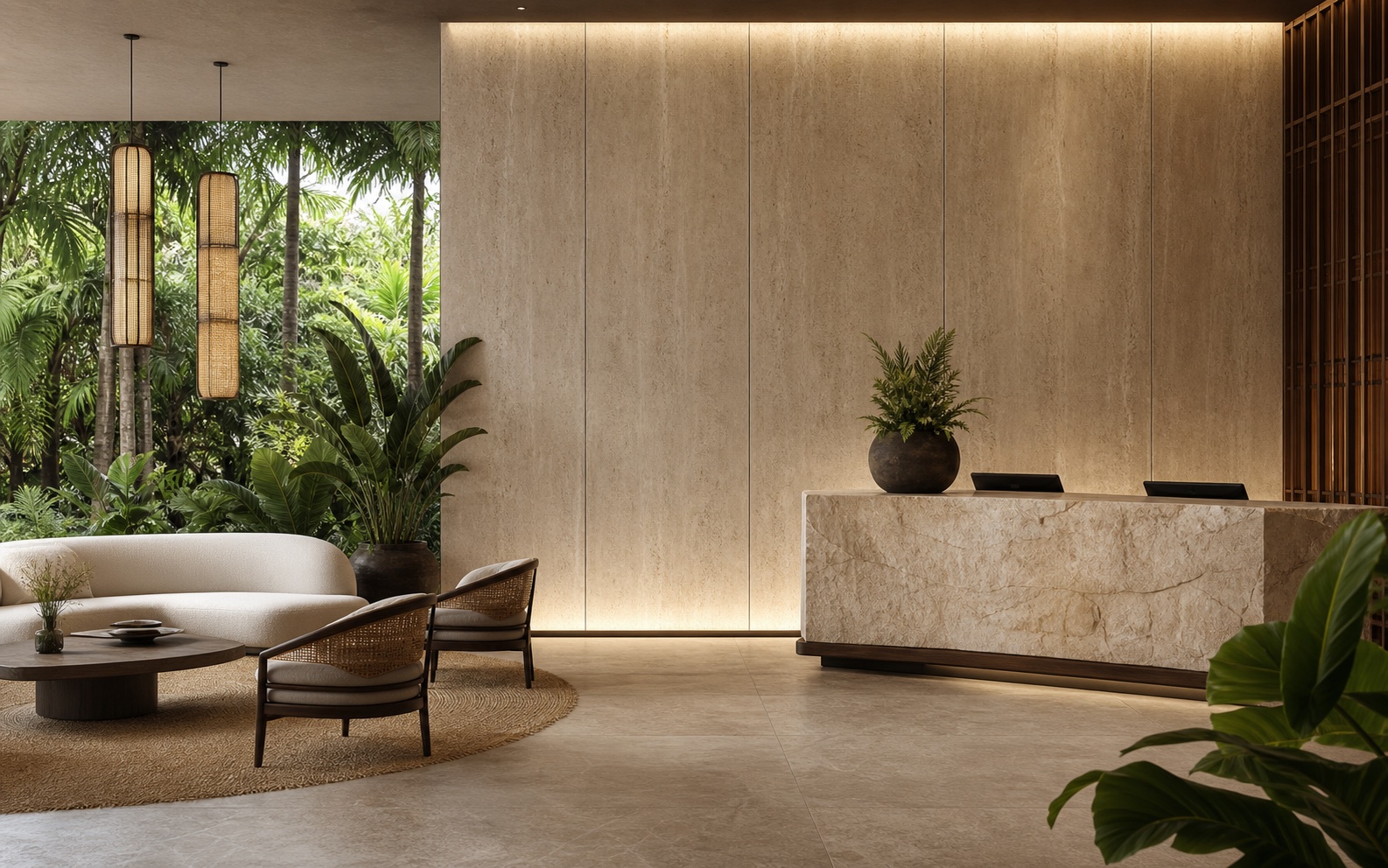
SYSTEM · Manufacturer Declared
Hotel reception wall
Large-format interior wall panels with specified substrate, adhesive, joints and edge trims.
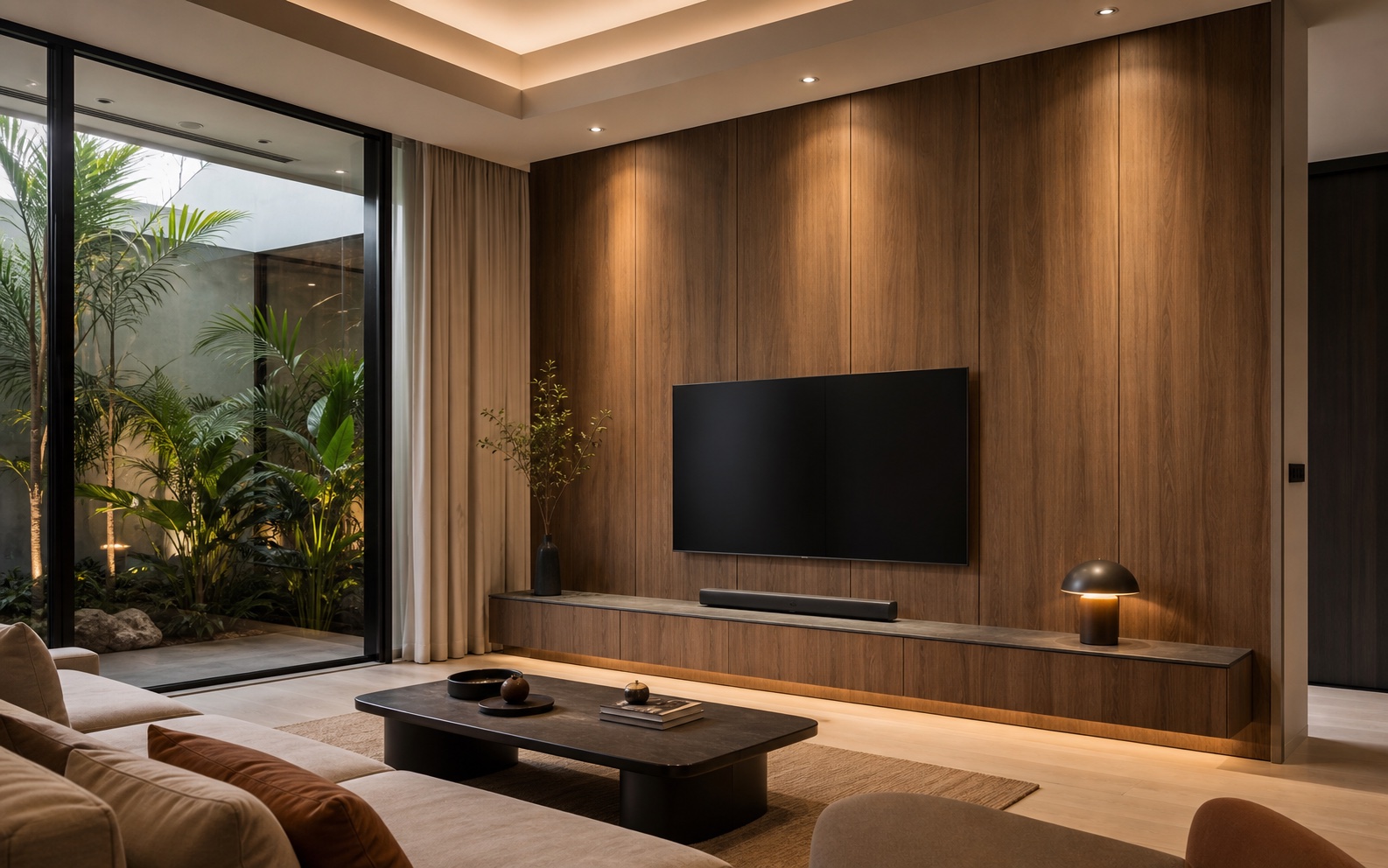
SYSTEM · Manufacturer Declared
Apartment feature wall
Purpose-designed wall panel, not an assumed reuse of a floating floor plank.
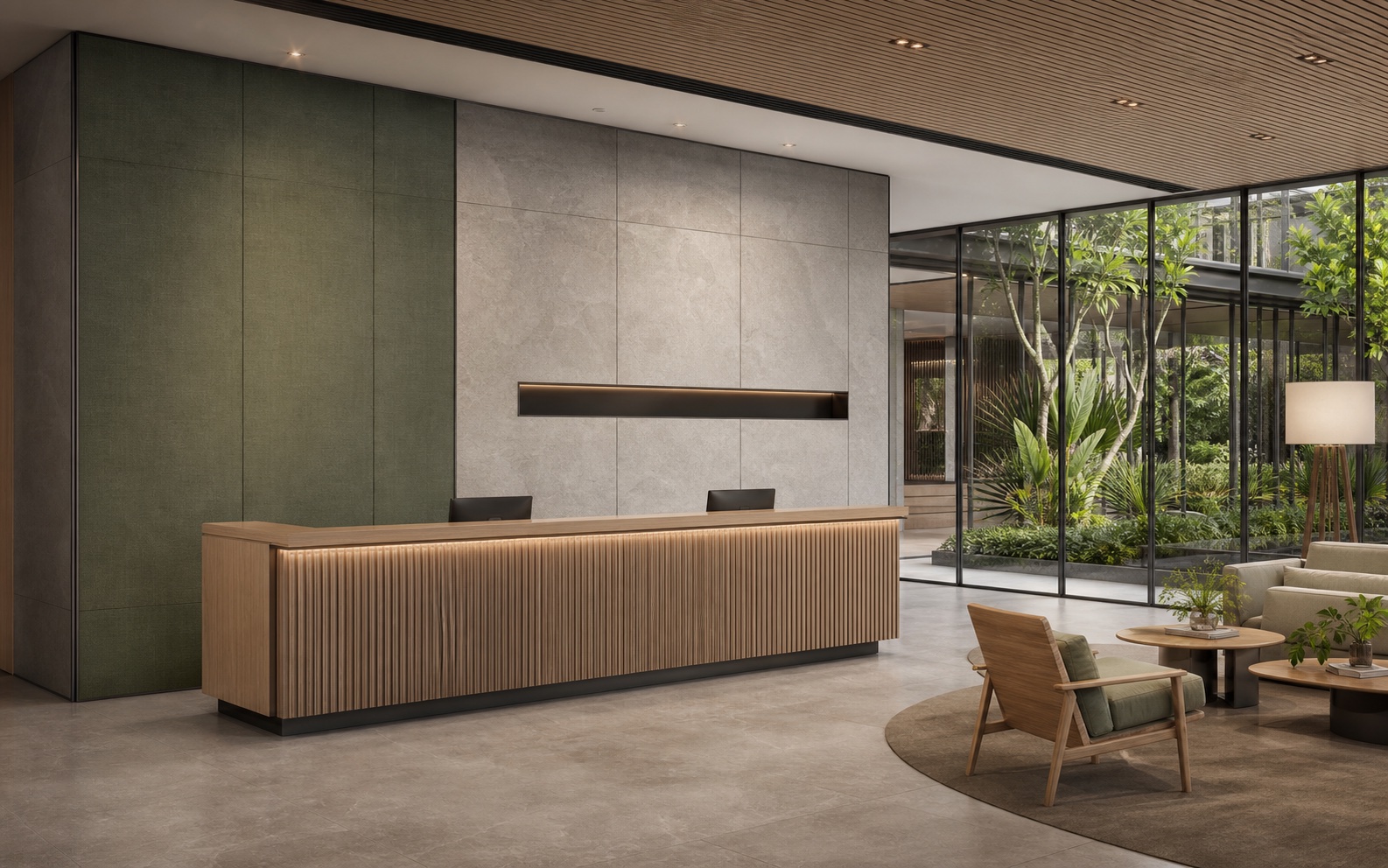
SYSTEM · Pending Verification
Office reception wall
Commercial interior feature walls subject to fire, impact and fixing-system review.
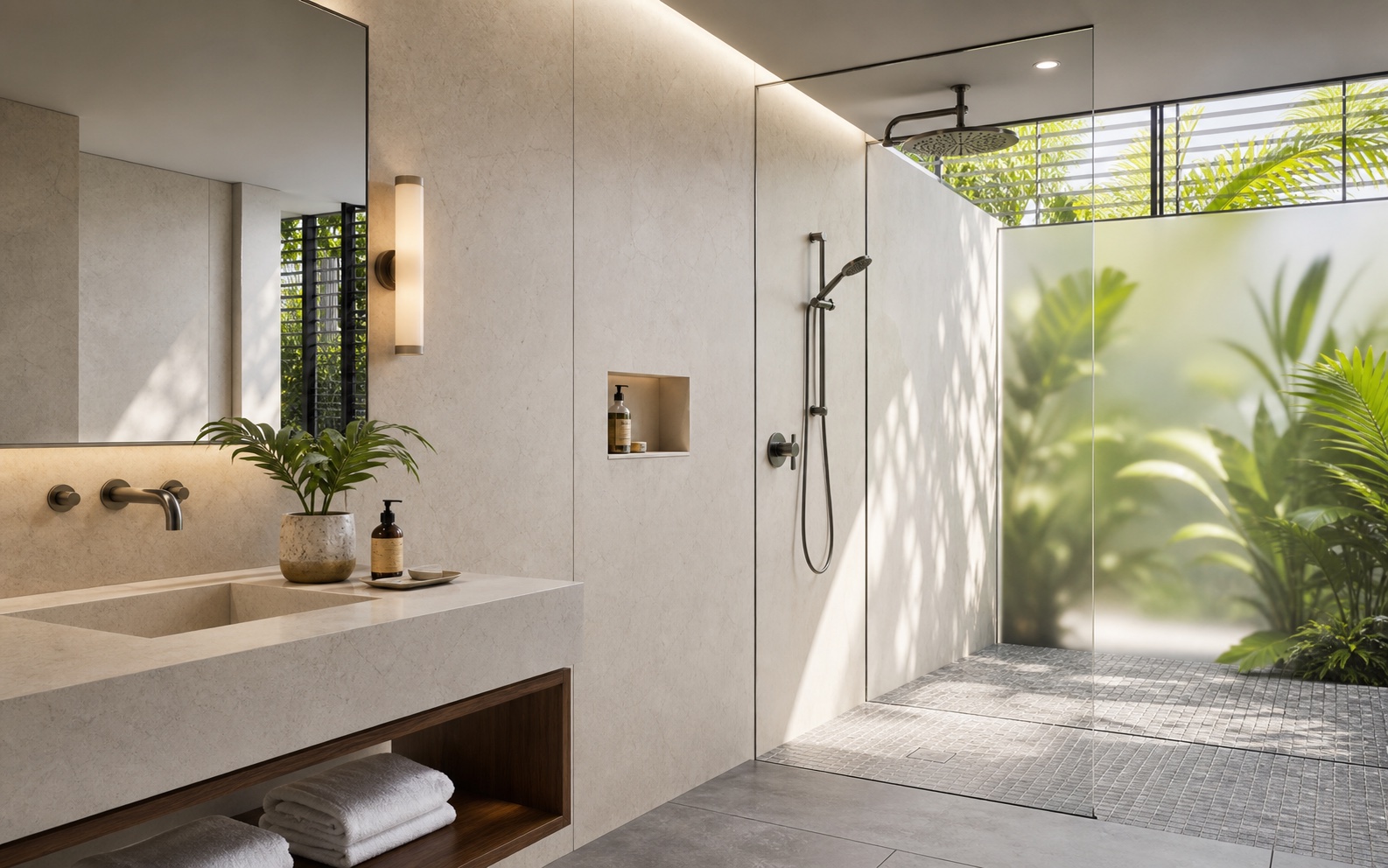
SYSTEM · Pending Verification
Bathroom wet-wall system
Only a manufacturer-rated wet-wall panel system with sealed joints, corners, penetrations and prepared waterproof substrate; the shower floor remains non-slip tile.
16
Priority markets
The country recommendation index combines climate and material fit, project demand, installation and maintenance, compliance complexity and local case evidence. It is an updateable UBI assessment—not a market-size, sales or investment-return forecast.
90/100
PrimaryVietnam
Strong fit for humid-climate apartments, hotels and rapid interior refurbishment; exact fire, VOC and supplier documentation still govern selection.
- BEST FIT
- Hotels · apartments · schools · office refurbishment
- EVIDENCE STATUS
- Market Reference
88/100
PrimaryIndonesia
Useful moisture tolerance and fast dry installation for dense urban housing and hospitality; island logistics and substrate quality require project control.
- BEST FIT
- Apartments · hospitality · retail · offices
- EVIDENCE STATUS
- Market Reference
87/100
PrimaryPhilippines
Good alignment with humid interiors, condominium and hotel renovation, supported by manufacturer project references; local code and product evidence remain SKU-specific.
- BEST FIT
- Condominiums · hotels · offices · public interiors
- EVIDENCE STATUS
- Market Reference
85/100
PrimaryMalaysia
High-humidity indoor fit and rapid replacement value for apartments, hotels and offices; solar exposure and slab moisture need disciplined detailing.
- BEST FIT
- Apartments · hotels · offices · education
- EVIDENCE STATUS
- Market Reference
84/100
PrimaryThailand
Suitable for hospitality, rental housing and retail refurbishment where downtime matters; wet areas and sun-exposed zones require separate systems.
- BEST FIT
- Hospitality · rental housing · retail
- EVIDENCE STATUS
- Market Reference
80/100
SecondaryCambodia
Potential fit for standardized urban housing, hotels and fit-out projects; installer capability and product-document consistency require verification.
- BEST FIT
- Housing · hotels · commercial fit-out
- EVIDENCE STATUS
- Market Reference
80/100
SecondaryChile
Manufacturer project references support retail use, while controlled interiors suit rigid-core systems; seismic joints and local compliance remain project matters.
- BEST FIT
- Retail · apartments · office refurbishment
- EVIDENCE STATUS
- Manufacturer Declared
79/100
SecondaryUnited Arab Emirates
Fast refurbishment and wood-look interiors suit hospitality, retail and residential projects; intense solar gain makes heat and glazing-zone controls essential.
- BEST FIT
- Retail · hotels · residential refurbishment
- EVIDENCE STATUS
- Verified
78/100
SecondarySaudi Arabia
Potential in hospitality, apartment and large fit-out programmes; heat exposure, fire documentation and local conformity require current project review.
- BEST FIT
- Hospitality · apartments · commercial interiors
- EVIDENCE STATUS
- Market Reference
77/100
SecondaryMexico
Potential for multi-family housing, hospitality and retail refurbishment across varied climates; regional product, heat and compliance selection is necessary.
- BEST FIT
- Multi-family housing · hospitality · retail
- EVIDENCE STATUS
- Market Reference
76/100
SecondarySingapore
Technically suitable for controlled interiors and rapid renovation, but stringent documentation and strong alternative materials raise the selection threshold.
- BEST FIT
- Hotels · offices · selected residential renovation
- EVIDENCE STATUS
- Market Reference
72/100
WatchlistKazakhstan
Rigid-core interiors may suit apartments and hospitality, but heating cycles, cold-weather logistics and current conformity requirements need verification.
- BEST FIT
- Apartments · hotels · office interiors
- EVIDENCE STATUS
- Pending Verification
68/100
WatchlistChina
Strong technical and manufacturing familiarity, but intense domestic competition reduces opportunity differentiation for a generic SPC offer.
- BEST FIT
- Renovation · hospitality · differentiated wall systems
- EVIDENCE STATUS
- Market Reference
64/100
WatchlistUkraine
Potential future relevance to housing and interior reconstruction, while current delivery, project timing and conformity conditions require continuous review.
- BEST FIT
- Housing refurbishment · public interiors
- EVIDENCE STATUS
- Pending Verification
60/100
WatchlistRussia
Controlled indoor applications are technically possible, while current trade, logistics, certification and commercial conditions require case-by-case review.
- BEST FIT
- Residential and hospitality interiors subject to review
- EVIDENCE STATUS
- Pending Verification
17
Procurement decision chain
Developer and hotel ownerArchitect and interior designerEPC, main contractor and fit-out contractorImporter, distributor and installerProject procurement team
- 1Project brief
- 2Design selection
- 3Sample approval
- 4Technical review
- 5Quotation and mock-up
- 6Commercial terms
- 7Production and inspection
- 8Logistics and installation
- 9Handover and after-sales
18
What UBI can provide
01Product–project matching
02Multi-factory quotation
03Samples and mock-up coordination
04BOQ and specification matching
05OEM / ODM
06Quality inspection
07Certification review
08Cross-border logistics
09Customs-document coordination
10Local partner cooperation
19
Project references
Evidence is tiered. ‘Verified Project’ means UBI checked a project-specific contractor or system-provider document; it does not mean UBI inspected the site. ‘Manufacturer Reference’ remains a supplier declaration until owner, architect or handover evidence is obtained.
9emerging-market project references2project-specific source documents
01Verified
Dubai, United Arab Emirates · Retail
Eye Zone · The Dubai Mall
- PRODUCT / SYSTEM
- Firmfit SPC flooring, 4 mm, over Sonixx Resilient 250 acoustic underlay
- DECLARED AREA
- 100 m²
- EVIDENCE
- Project-specific Interfloor case study names the outlet, floor finish, contractor, area and overnight installation.
Source evidence verified; UBI did not inspect the installation or its current condition.
Interfloor Sonixx case study — Eye Zone, The Dubai Mall02Verified
Dubai, United Arab Emirates · Residential refurbishment
Arabian Ranches residence refurbishment
- PRODUCT / SYSTEM
- Stone Polymer Composite parquet flooring
- DECLARED AREA
- 200 m²
- EVIDENCE
- Duphill contractor case study states the system, rooms, applied area and November 2022 completion.
Project-specific contractor evidence; not an independent post-occupancy performance audit.
Duphill case study — Arabian Ranches SPC03Manufacturer Declared
Makati, Metro Manila, Philippines · Hotel
Novotel Makati Manila
- PRODUCT / SYSTEM
- Diamond SPC, 5.2 mm including 1 mm IXPE, AC4 commercial reference
- DECLARED AREA
- 7,500 m² declared
- EVIDENCE
- Sensse project page names the hotel, construction and declared coverage, with a project gallery.
Manufacturer-declared reference; owner, architect and independent completion documents were not located.
Sensse project — Novotel Makati Manila04Manufacturer Declared
Metro Manila, Philippines · High-rise residential
Milano Residences Manila
- PRODUCT / SYSTEM
- SPC rigid flooring, 4.0 mm / 0.3 mm wear layer
- DECLARED AREA
- 25,000+ m² declared
- EVIDENCE
- Sensse project page identifies Milano Residences, the product construction and declared floor coverage.
Manufacturer-declared reference; exact installed zones and handover records require further verification.
Sensse project — Milano Residences05Manufacturer Declared
Makati, Metro Manila, Philippines · High-rise residential
Trump Tower Manila
- PRODUCT / SYSTEM
- Wood-veneered SPC hybrid, 8.2 mm with 1.2 mm wood veneer
- DECLARED AREA
- 21,500 m² declared
- EVIDENCE
- Sensse project page names the tower, hybrid SPC construction and declared coverage.
This is a wood-veneered SPC hybrid, not the same surface construction as standard printed-film SPC.
Sensse project — Trump Tower Manila06Manufacturer Declared
Cape Town, South Africa · Hotel
City Home Hotel Cape Town
- PRODUCT / SYSTEM
- SPC rigid flooring, 5.0 mm / 0.5 mm wear layer, click system
- DECLARED AREA
- 5,000+ m² declared
- EVIDENCE
- Sensse project page provides the hotel reference, format, construction and declared coverage.
Manufacturer-declared reference; the exact legal hotel name and independent completion record remain pending.
Sensse project — City Home Hotel Cape Town07Manufacturer Declared
Kenya · Residential
Nairobi–Kakamega residential project
- PRODUCT / SYSTEM
- SPC rigid flooring, 4.0 mm / 0.3 mm wear layer
- DECLARED AREA
- 2,500+ m² declared
- EVIDENCE
- Sensse project page identifies the Kenya project, click system and declared coverage.
Manufacturer-declared reference; the project entity and precise site require further verification.
Sensse project — Nairobi Kakamega08Manufacturer Declared
São Paulo, Brazil · Residential / resort
São Paulo apartment resort
- PRODUCT / SYSTEM
- SPC rigid flooring, 5.0 mm / 0.5 mm wear layer
- DECLARED AREA
- 12,000+ m² declared
- EVIDENCE
- Sensse project page states the city, segment, construction and declared coverage.
Manufacturer-declared reference; project name and third-party completion evidence remain pending.
Sensse project — São Paulo apartment resort09Manufacturer Declared
Santiago, Chile · Retail
Santiago shopping mall
- PRODUCT / SYSTEM
- SPC rigid flooring, 5.0 mm / 0.5 mm wear layer
- DECLARED AREA
- 6,000+ m² declared
- EVIDENCE
- Sensse project page states a Santiago shopping-mall reference, construction and declared coverage.
Manufacturer-declared reference; mall identity and independent handover documents remain pending.
Sensse project — Santiago shopping mall20
Certification and document center
Technical DatasheetTBC · Supplier document pending
Pending VerificationInstallation GuideTBC · Supplier document pending
Pending VerificationMaintenance GuideTBC · Supplier document pending
Pending VerificationWarrantyTBC · Supplier document pending
Pending VerificationFire TestTBC · Supplier document pending
Pending VerificationSlip ResistanceTBC · Supplier document pending
Pending VerificationVOC / Indoor Air QualityTBC · Supplier document pending
Pending VerificationHeavy MetalsTBC · Supplier document pending
Pending VerificationPhthalatesTBC · Supplier document pending
Pending VerificationFormaldehydeTBC · Supplier document pending
Pending VerificationSDSTBC · Supplier document pending
Pending VerificationEPDTBC · Supplier document pending
Pending VerificationPackaging DataTBC · Supplier document pending
Pending VerificationProject Submittal TemplateTBC · Supplier document pending
Pending Verification21
Frequently asked questions
01Is SPC the same as WPC?
No. This page concerns a dense rigid SPC core. WPC commonly refers to a different, foamed composite core with a softer feel.
02Can SPC replace tile?
Not universally. Tile remains more appropriate for many wet, outdoor, high-temperature and heavy-duty conditions.
03Is an SPC floor waterproof?
The board can be highly moisture resistant, but that does not make joints, walls, penetrations and the full floor assembly waterproof.
04Can it be installed over existing tile?
Sometimes, if the tile is sound, clean, dry and flat and transitions remain workable. Follow the selected manufacturer's requirements.
05Is ordinary SPC suitable outdoors?
Generally no. Rain, solar gain, thermal cycling, drainage and substrate moisture require an outdoor-rated system with product-specific weathering, heat-stability and slip evidence.
06Is SPC suitable for schools, hospitals and public housing?
It can suit classrooms, offices, ordinary residential areas, hotel rooms and non-special hospital support areas when wear, fire, slip, VOC, cleaning and substrate requirements are verified. Laboratories, sterile rooms, wet treatment areas, commercial kitchens and heavy workshops need a different project-specific system.
07Can SPC be installed on a wall?
Yes—SPC is available as a purpose-designed interior wall-panel system. Select a product approved for vertical use, then follow its substrate, adhesive or mechanical fixing, joint, edge, fire and warranty requirements. Do not assume every floating floor plank is automatically wall-rated.
08How should environmental performance be judged?
Review current third-party VOC, heavy-metal, phthalate and other relevant reports for the exact product—not general marketing claims.
09Can UBI coordinate samples and OEM?
UBI can coordinate project samples, supplier comparison and OEM/ODM requirements subject to supplier confirmation.
22
Sources, verification and disclaimer
Sources
RFCI — Rigid CoreAccessed 2026-07-11 · Pending Verification · Pending Verification · Pending Verification · UBI Research · 2026-07-11RFCI — Resources & ASSURE certificationAccessed 2026-07-11 · Pending Verification · Pending Verification · Pending Verification · UBI Research · 2026-07-11Shaw — Resilient Installation Guidelines for SPC ProductsAccessed 2026-07-11 · Pending Verification · Pending Verification · Pending Verification · UBI Research · 2026-07-11Karndean — Rigid Core Installation Format and CollectionsAccessed 2026-07-11 · Pending Verification · Pending Verification · Pending Verification · UBI Research · 2026-07-11Karndean — Korlok Select Technical Data SheetAccessed 2026-07-11 · Pending Verification · Pending Verification · Pending Verification · UBI Research · 2026-07-11Tarkett — Elegance Rigid 55 SPCAccessed 2026-07-11 · Pending Verification · Pending Verification · Pending Verification · UBI Research · 2026-07-11Vilo — SPC Wall PanelsAccessed 2026-07-11 · Pending Verification · Pending Verification · Pending Verification · UBI Research · 2026-07-11Kermit Floor — SPC Floors, Walls and SkirtingsAccessed 2026-07-11 · Pending Verification · Pending Verification · Pending Verification · UBI Research · 2026-07-11Brodecor — NextStep SPC Wall PanelAccessed 2026-07-11 · Pending Verification · Pending Verification · Pending Verification · UBI Research · 2026-07-11Interfloor — Eye Zone at The Dubai Mall SPC case studyAccessed 2026-07-11 · Pending Verification · Pending Verification · Pending Verification · UBI Research · 2026-07-11Duphill — Arabian Ranches SPC refurbishment case studyAccessed 2026-07-11 · Pending Verification · Pending Verification · Pending Verification · UBI Research · 2026-07-11Sensse Floor — SPC and hybrid SPC project libraryAccessed 2026-07-11 · Pending Verification · Pending Verification · Pending Verification · UBI Research · 2026-07-11Last updated
2026-07-11
Market ReferenceDisclaimer
This page presents a product and market opportunity. It is not investment advice or a final technical commitment. Final specifications, certification, warranty, lead time and pricing are governed by signed contracts and supplier documents.